Mandala · May 2026
The Art and Geometry of Mandala Tattoos
A complete guide to the history of mandalas, their connection to sacred geometry, what separates an exceptional mandala tattoo from an average one, and how to care for your new piece.
What Is a Mandala?
The word mandala comes from Sanskrit, meaning circle. But a mandala is far more than a shape — it is a visual representation of the universe, of wholeness, of the infinite returning to its centre.
Mandalas have appeared independently across cultures for thousands of years. In Hinduism and Buddhism they serve as sacred diagrams used in meditation and ritual, helping the mind focus inward. Tibetan monks spend days creating intricate sand mandalas — only to destroy them upon completion, as a reminder of impermanence. In Carl Jung's psychology, the mandala became a symbol of the self, appearing spontaneously in the dreams and drawings of his patients as a sign of psychological integration.
What connects all of these traditions is the same underlying structure: a centre point, radiating outward in perfect symmetry.
Mandalas and Sacred Geometry
Sacred geometry is the idea that certain mathematical patterns and proportions are the building blocks of the natural world — and by extension, of consciousness itself. The circle divided into 6, 12, or 24 equal parts. The Flower of Life. The Vesica Piscis. The golden ratio. These are not decorative inventions — they are patterns found in the growth of plants, the structure of crystals, the movement of planets.
When a mandala is constructed using these proportions, something shifts. The design stops being decoration and becomes something that resonates on a deeper level. The viewer feels the order in it, even if they cannot explain why. This is why a well-constructed mandala tattoo reads differently from one that is simply drawn to look symmetrical. The geometry either holds, or it does not.
How I Design Mandala Tattoos
Every mandala I create starts from a single centre point and builds outward using repetitions of 6, 12, or 24 — the same divisions found in traditional sacred geometry. I work digitally using the Geometrica app, which allows me to construct these divisions with mathematical precision before a single line is committed to skin.
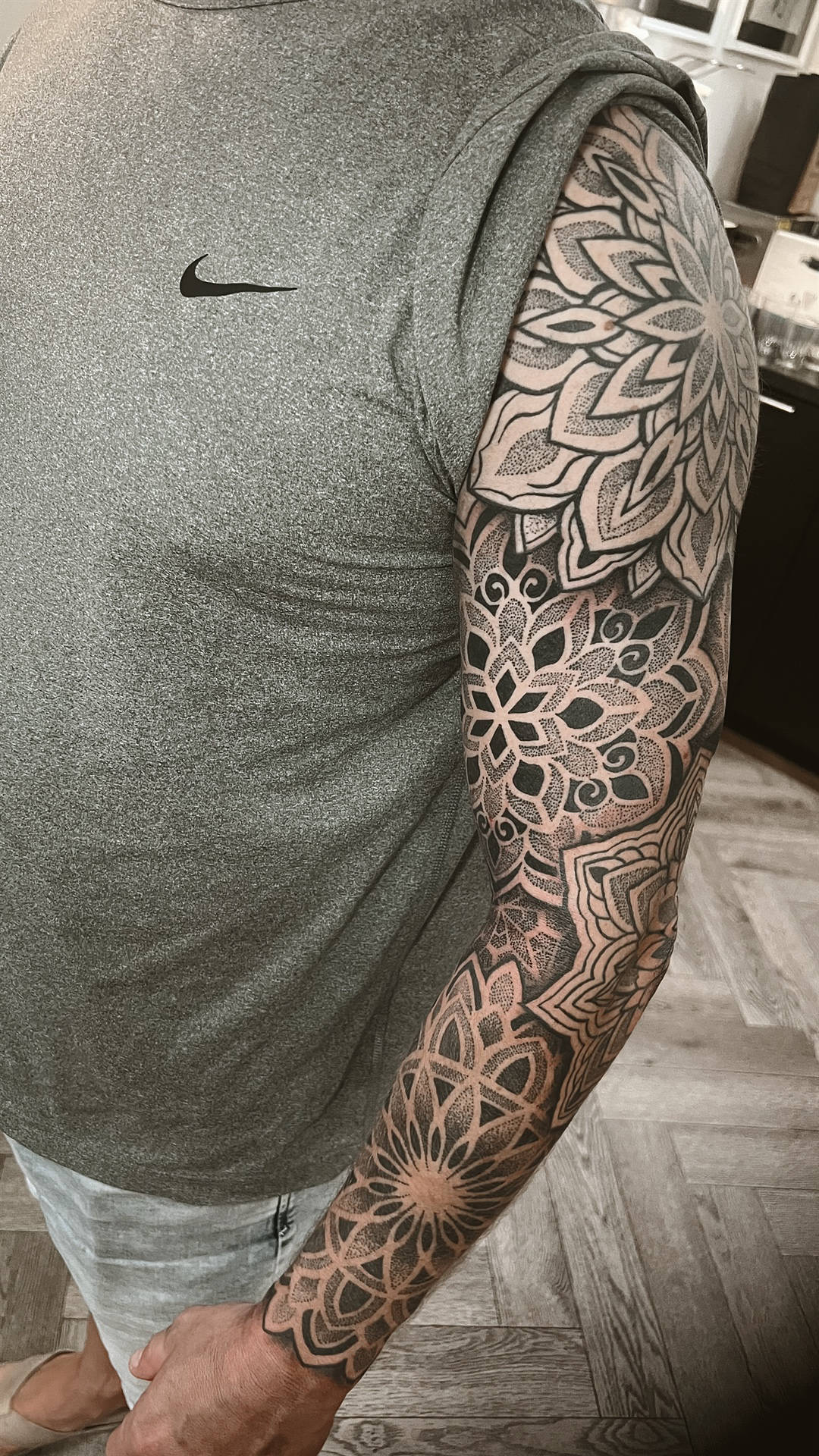
The focus throughout is on two things: alignment and contrast. Perfect alignment means the geometry is true — every petal, every line, every dot sits exactly where it should. Contrast means the design reads boldly from a distance while rewarding close inspection with fine detail — combining dotwork, solid black elements, and smooth shading within the same piece.
When a client comes with reference images or specific elements they want incorporated, I use those as a foundation and rebuild from scratch around the geometry of their body placement. A mandala on a shoulder blade behaves differently to one on a forearm — the curvature of the body, the way light hits the skin, the way the piece will be seen in daily life — all of this shapes the design before I draw a single line.
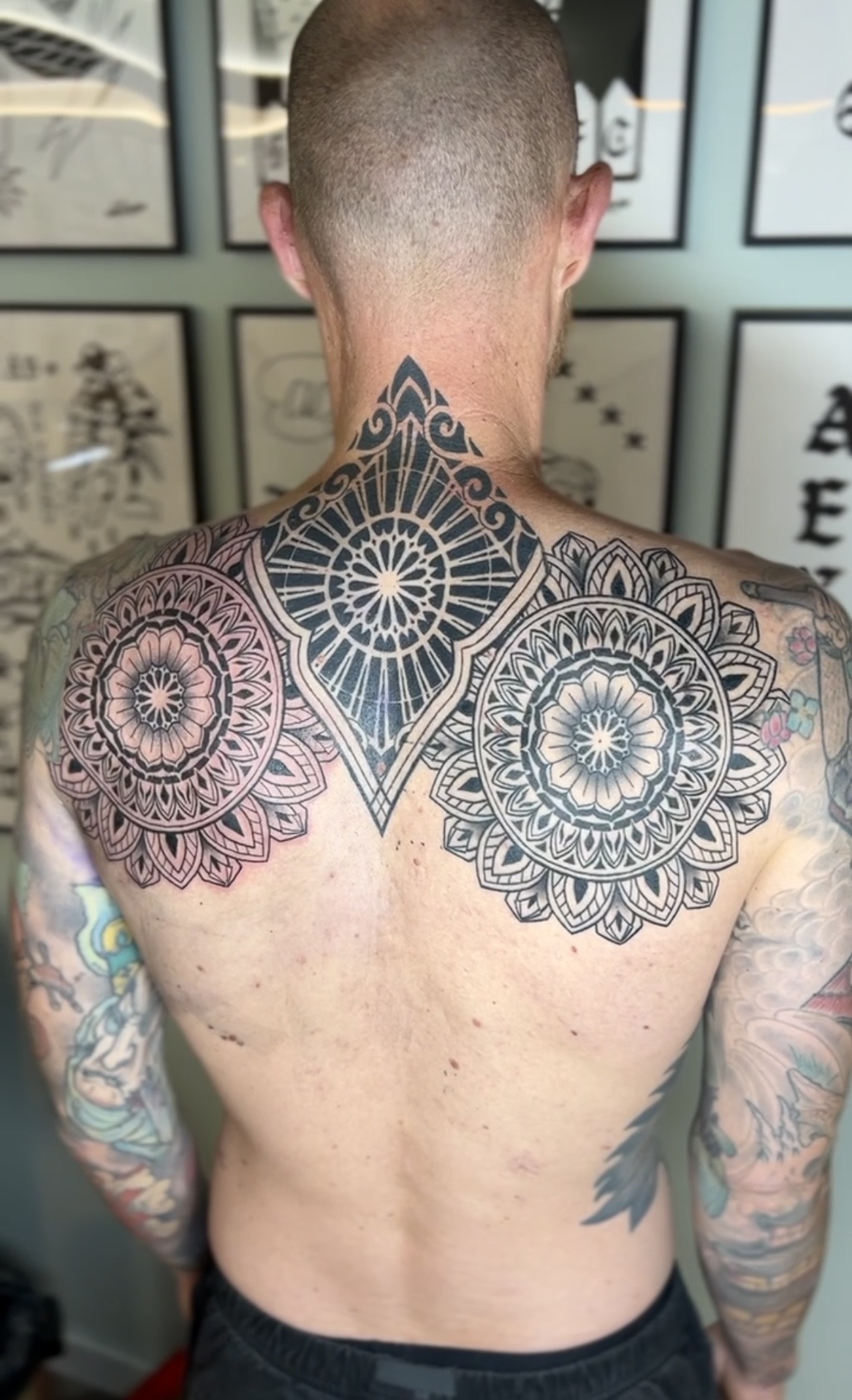
One of the most rewarding projects I have worked on was a large upper back piece for a client who wanted bold mandalas on both shoulder blades, connected by a piece extending into the neck. The brief was to feel powerful and commanding, while remaining intricate enough that the detail would reveal itself the closer you looked. That balance — boldness and subtlety coexisting — is what I chase in every mandala I design.
What Makes a Quality Mandala Tattoo
Not all mandalas are created equal. Here is what separates a truly exceptional mandala from one that simply looks good in a photo:
Geometric accuracy
Every division must be mathematically correct. Even a fraction of a degree off-centre becomes visible over a large piece — and over time, imprecision becomes more pronounced, not less.
Contrast and depth
A flat mandala where all elements carry the same visual weight reads as two-dimensional. Layering dotwork, shading, and solid black creates depth that makes the piece feel alive on the skin.
Body-specific design
A mandala copied from a reference and scaled to fit a body placement is not the same as one designed for that placement from the beginning. The symmetry must account for the natural curves and contours of the body it lives on.
Longevity
Bold, well-structured geometric work ages exceptionally well. Fine lines without enough contrast can blur over time. A mandala designed with longevity in mind will still look sharp decades from now.
Mandala Tattoo Aftercare
Getting the aftercare right protects everything that went into the design. Here is exactly what I recommend to every client:
Immediately after the session, I cover the fresh tattoo with second skin — a breathable, transparent film that protects the area while it begins to heal. Leave this on for up to two days, though removing it sooner is fine too.
Removing second skin: Do this gently in the shower. Warm water loosens the adhesive and makes removal comfortable. Once removed, clean the tattoo carefully with water, or water combined with a mild antibacterial soap. Pat dry with a clean towel — never rub.
Moisturising: Apply a thin layer of a gentle ointment such as Bepanthen. The key principle is simple — do not let it dry out. Rather than applying ointment on a fixed schedule, pay attention to how the skin feels. The moment it starts to feel tight or dry, apply a little more. This way you avoid both over-moisturising and under-moisturising.
Healing timeline: Most clients find the surface skin closes within 2 to 3 weeks. Full skin recovery typically takes 5 to 6 weeks. During this period, avoid direct sun exposure on the tattoo, stay out of swimming pools and open water, and resist the urge to pick or scratch. A well-healed mandala is a sharp mandala.
Get Tattooed
Ready to Begin?
I take on a limited number of custom mandala projects each month. Free consultation available.
Book a Free Consultation