Geometric · July 2026
Geometric vs Mandala Tattoos
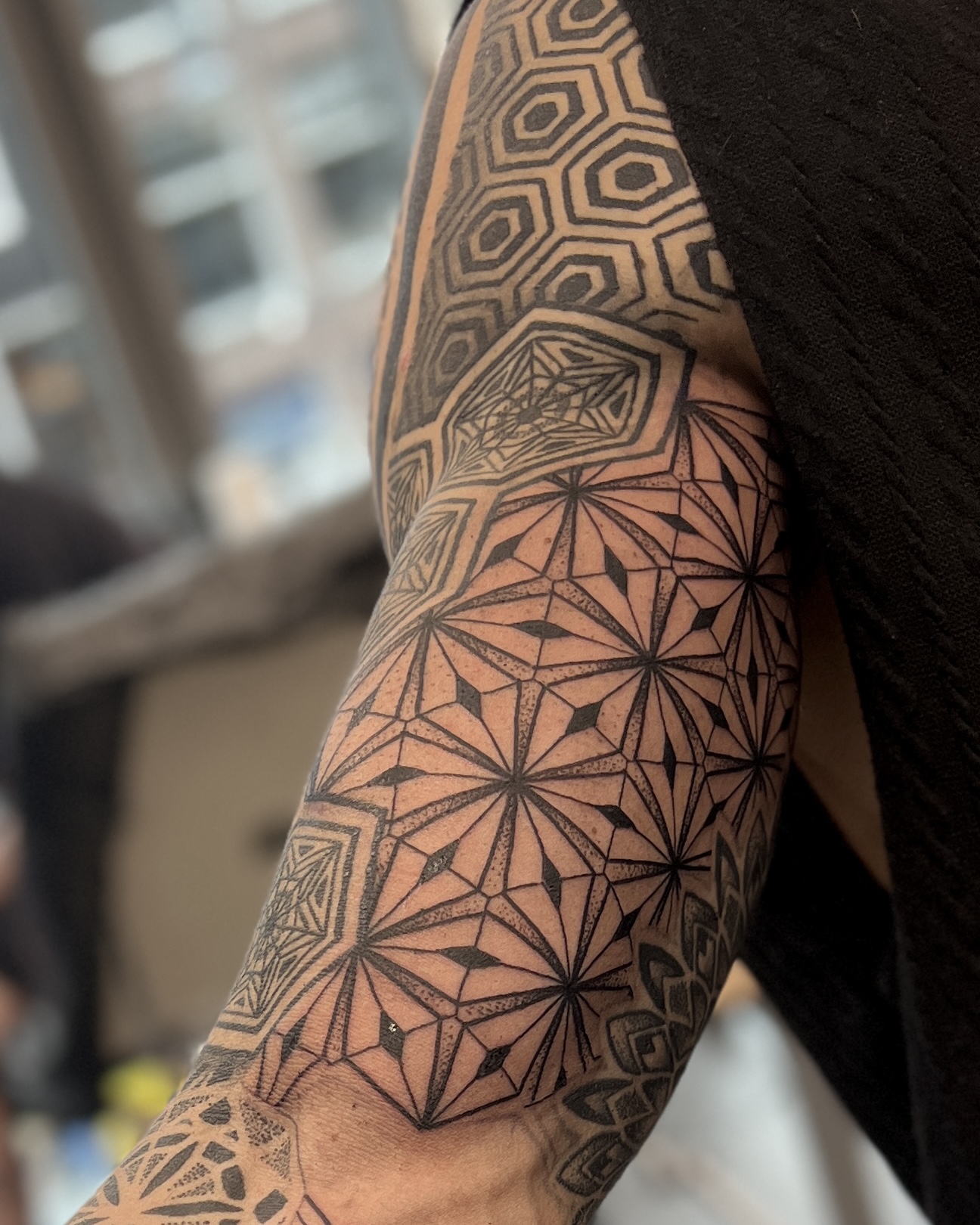
Clients often ask for "a geometric tattoo" when they mean a mandala, or vice versa. Both disciplines share a language of precision — but the way that precision is used, and what it produces on skin, is fundamentally different.
What Defines a Geometric Tattoo
A geometric tattoo is built from pure form — straight lines, precise angles, triangles, hexagons, overlapping polygons. There is no requirement for a single centre point or radial symmetry. The composition can flow across the body in any direction: following the line of a forearm, wrapping a shoulder, cutting diagonally across a ribcage.
What makes geometric work difficult is not the individual shapes — it is the relationships between them. A single degree of misalignment in a triangle grid becomes obvious the moment light hits the skin differently. Every line has to hold its angle exactly, because there is nothing else for the eye to focus on. The precision is the design.
What Defines a Mandala Tattoo
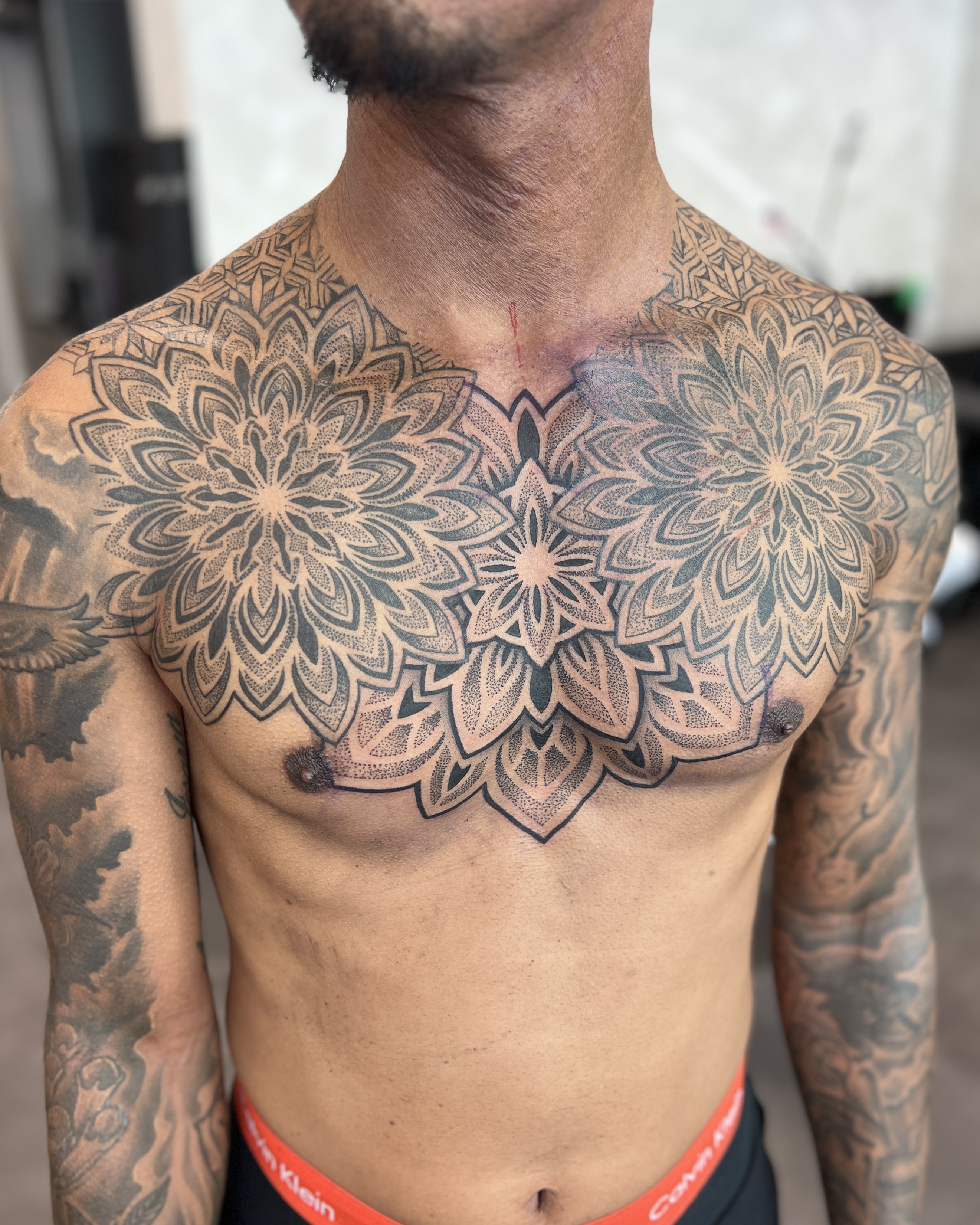
A mandala, by contrast, always starts from a single centre point and radiates outward in perfect symmetry — typically divided into 6, 12, or 24 equal sections. Where geometric tattoos can travel across the body in any direction, a mandala is anchored. It has a heart, and everything else is built in relation to it.
This is why mandalas carry a different weight than geometric pieces. The radial symmetry echoes patterns found throughout nature and sacred geometry traditions — the same structure behind a flower, a snowflake, a sand mandala built by Tibetan monks. A mandala tattoo doesn't just decorate the body; it centres it.
The Key Differences
Once you know what to look for, the two disciplines are easy to tell apart:
Structure
Geometric work is directional and linear. Mandala work is radial, built outward from a fixed centre.
Placement
Geometric designs adapt freely to almost any part of the body. Mandalas work best where a clear centre point makes sense — a shoulder blade, the sternum, the crown of the shoulder.
Feel
Geometric tattoos often feel architectural — sharp, modern, structural. Mandalas feel more ceremonial, rooted in centuries of spiritual tradition.
Where they meet
In practice, the two are rarely fully separate. A mandala is, technically, a specific application of geometric principles — and many of my strongest pieces combine a radial mandala centrepiece with geometric linework extending outward across the body.
Which One Is Right for You?
If you're drawn to something bold, architectural, and free to follow the natural lines of your body — geometric is likely your starting point. If you want a piece that feels anchored, symbolic, and complete in itself — a mandala is the better foundation.
Many clients don't need to choose. During a consultation, I look at the placement, the story behind the piece, and how it should sit against the body — then design in whichever direction, or combination, actually serves the piece. For aftercare guidance that applies to both styles, see my mandala tattoo aftercare guide.
Get Tattooed
Ready to Begin?
I take on a limited number of custom geometric and mandala projects each month. Free consultation available.
Book a Free Consultation